



連続圧延機
/Inside the Mill: A Practical Look at QST for Bar & Wire If you’ve ever stood beside a hot rolling line, you know strength is “made” in seconds. The Water Quenching Process sits right at that moment—where heat, water, and timing turn ordinary bar and wire into reliable reinforcement. I’ve watched operators swear by it, and to be honest, I’ve seen skeptics converted after the first batch passes mechanical tests. What’s changing in the industry Trends are obvious on the ground: mills want lower alloy costs, higher grades, and consistent yields. Controlled rolling with POMINI-mode cooling is back in the conversation because it cuts alloy addition and reduces cooling-bed load. Many customers say uptime and recipe repeatability matter more than ever; surprisingly, a smart QST rig often pays back within a year in mid-volume mills. Process flow: how the magic happens Materials: carbon steel bar/wire (e.g., 20MnSi; rebar grades HRB335/HRB400/HRB500; ASTM A615/A706 equivalents). Method: finish rolling at ≈ 950–1050°C; immediate Water Quenching Process to form a martensitic rim; self-temper via core heat; equalization; cooling bed. Testing standards: GB/T 1499.2, ASTM A615/A706, EN 10080; bend/rebend, yield/tensile, elongation, rib geometry, hardness sampling. Service life: pumps MTBF ≈ 20,000 h; headers/nozzles ≈ 6–12 months or 5,000–10,000 t (real-world use may vary). Industries: construction steel, infrastructure rebar, wire rod for fasteners and mesh. Product: Water Quenching System (YWLX) Origin: No.1518, LAR Valley Int'l, Guang’anmen Avenue, Xicheng District, Beijing, 100055. The system re-forms traditional practice—less alloy, more control. It has successfully produced third-grade rebar with 20MnSi, upgrading second-grade stock with lower cooling-bed load. The new tech adopts POMINI-mode controlled rolling and cooling at low cost. Spec Typical Value Product range Bars Ø10–Ø50 mm; wire rod Ø5.5–Ø16 mm Line speed Bars 3–14 m/s; wire up to ≈18 m/s Water pressure / flow 0.8–1.6 MPa; ≈150–800 m³/h (grade & size dependent) Cooling-bed load reduction ≈30–40% Controls PLC + recipe library; POMINI-mode logic Materials Headers SS316L; modular laminar nozzles Certifications ISO 9001; CE (upon request) Applications, customization, and field results Use cases: rebar for bridges, high-rises, and precast; wire for mesh and anchors. Customization includes header length, staged zones, nozzle patterns, water-recovery skids, and inline mechanical test integration. In one Northern China mill, 20MnSi was upgraded from “second-grade” target to HRB400-like performance via Water Quenching Process , trimming alloy costs ≈8–12% and lifting line throughput ≈5% (thanks to reduced cooling-bed bottlenecks). Test data (acceptance run, bar Ø20 mm, internal lab): YS 435–470 MPa, UTS 600–650 MPa, A5 16–19%, uniform rib height within spec; surface hardness gradient shows tempered martensitic rim with ferrite–pearlite core—classic QST profile. Customers reported smoother bends and fewer rebend rejections. Vendor comparison (quick glance) Feature YWLX Water Quenching System Generic Vendor A Integrated Line Supplier B Control fidelity POMINI-mode, recipe tuning Basic valves Good, but pricier Alloy savings High (field-proven) Medium High Customization Deep, modular Limited Moderate Lead time ≈12–18 weeks ≈10–16 weeks ≈20–28 weeks After-sales Onsite + remote tuning Remote only Onsite, schedule-heavy Why it matters The Water Quenching Process stabilizes mechanical properties without chasing high-alloy chemistries. It seems “boring hardware,” but the right turbulence, pressure, and dwell window at the run-out table changes everything. Actually, that’s where real mill profits show up. Customer feedback, briefly “More consistent YS hit rate, less over-hard.” “Cooling-bed jams dropped—shift tempo improved.” “Recipe changes between Ø12 and Ø25 now take minutes.” Compliance & documentation Delivered with ISO 9001 quality docs; supports test plans to ASTM A615/A706, GB/T 1499.2, and EN 10080. Mill certifications and heat maps available on request. Citations GB/T 1499.2 Steel for the reinforcement of concrete—Part 2: Hot rolled ribbed bars. ASTM A615/A615M Standard Specification for Deformed and Plain Carbon-Steel Bars for Concrete Reinforcement. EN 10080 Steel for the reinforcement of concrete—Weldable reinforcing steel—General. ISO 9001:2015 Quality management systems—Requirements. ASM Handbook, Volume 4: Heat Treating; and QST references incl. Tenova Pomini public technical notes.

We have successfully executed over 500
projects around the world,
many first-of-their-kind
research projects and products in China, including
We have successfully executed over 500
projects around the world,
many first-of-their-kind
research projects and products in China, including
-
2004
The 1st hydraulic AGC system for hot rolling of ribbon steel
-
2006
The 1st AFC system used for 1450mm skin pass mill
-
2009
The 1st 5-stand tandem line with 2-stand POR & Uncoiler for 650mm ribbon steel
-
2012
The 1st reversing mill for 1380mm strip
-
2016
The 1st soft-rolling system used in skin pass mill
-
2019
The 1st fully automated medium-width tandem cold rolling mill
-
2021
The 1st 5000KN Twin-stand double skin pass mill
-
2022
The 1st coupled pickling line & tandem cold mill with two modes - big roller & small roller
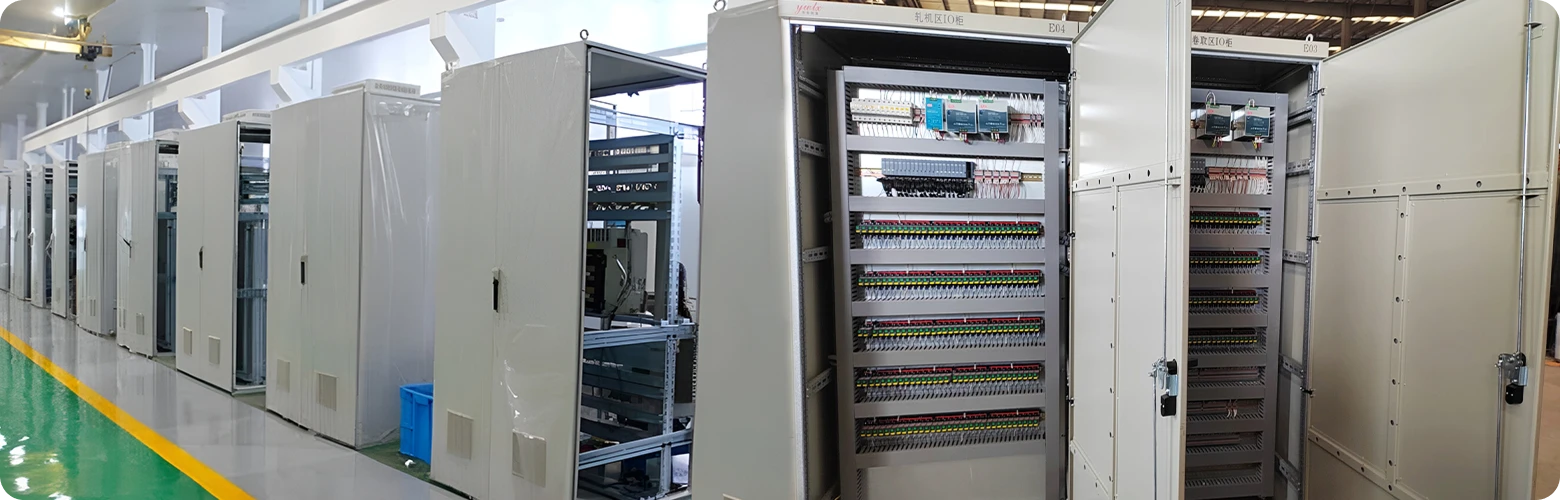

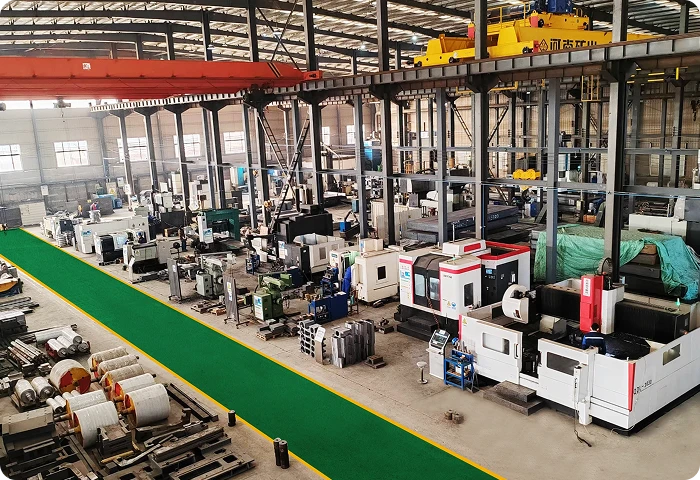
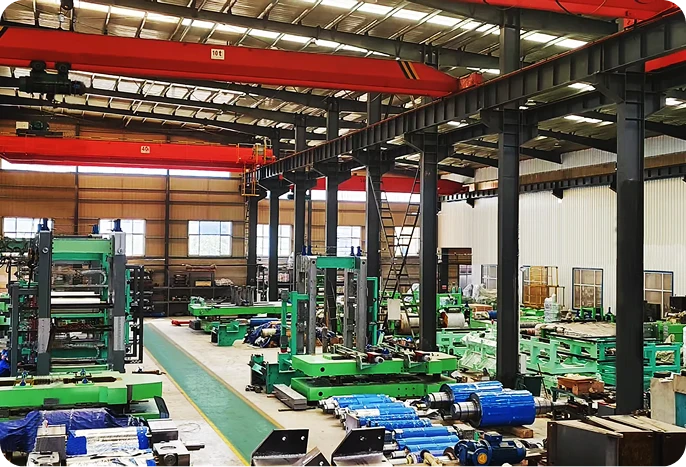
Yang Wang Li Xin operates a state-of-the-art facility over 66,000 square meters,and our manufacturing facility is fully equipped with high-tech machinery and high-capacity cranes. This enables us to handle large work pieces measuring 4.5m in width, 10m in length, and 1.5m in height, guaranteeing our capacity to produce 1800mm skin-pass mills and 1450mm rolling mills. The individual piece can weigh up to 100 tons.


Quality is fundamental to the enterprise survival. We have established a comprehensive and meticulous quality management system and have successfully obtained ISO14000 certification. Starting from the design source, it supervises the entire production cycle, including design, procurement, processing, assembly, in-factory testing, installation, and online commissioning. The workshop is equipped with measuring tools like vernier calipers, spectrometers, hardness testers, and ultrasonic flaw detectors. They are used to check materials and control tolerances to ensure the final equipment meets or exceeds requirements. All products have a unique code, This enables the easy identification and traceability of the equipment components and ensures full control of quality.


-
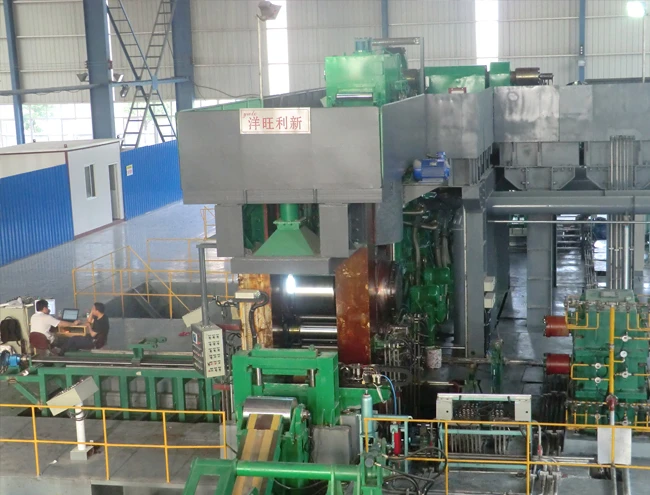 custom millsUnderstanding Custom Mills The Backbone of Tailored Manufacturing In the age of mass production, where standardization often reigns supreme, custom mills have emerged as vital players in the manufacturing sector, offering unique services that cater to specific client needs. Custom mills specialize in processing materials, ranging from metals to plastics, and tailoring their products to meet the ex
 -
 strip rolling equipmentStrip rolling equipment plays a crucial role in the metalworking industry, primarily in the manufacturing of thin and uniform strips of metal. The equipment's importance stems not just from its engineering design but also from the precision it brings to modern industrial processes. Engineers and manufacturers who utilize strip rolling equipment require a deep understanding of its mechanics, capabi
 -
Optimized Water Cooling System for Water Tank | Efficient & StableWater cooling system for water tank, cooling water expansion tank, and cooling water storage tank are key solutions in the Industrial Manufacturing industry, specifically within Process Cooling and Heavy Equipment Operation. This article explores how Beijing Yang Wang Li Xin Sci&Tech Co.,Ltd. supports professionals with durable, high-performance products, and explains why this product is an ideal


